

Paint Booth Fire Suppression: Are You Fully Protected?
If your facility uses a paint booth, you already know the risks are different from a typical workspace. Between flammable paints, solvents, vapors, and overspray, it doesn’t take much for a small ignition source to turn into a serious fire.
That’s why paint booth fire protection needs to be designed correctly, maintained regularly, and compliant with industry standards like NFPA 33 to protect your people, equipment, and operations.
Why Paint Booths Are High-Risk Environments
Paint booths create a perfect storm for fire hazards:
- Flammable liquids and coatings
- Combustible overspray buildup
- Airflow systems that can spread fire quickly
- Electrical components and potential ignition sources
Even with proper ventilation, vapors can accumulate, and when they do, they can ignite fast.
NFPA 33: The Standard That Guides Paint Booth Safety
National Fire Protection Association (NFPA) 33 is the gold standard, outlining how to reduce fire and explosion risks in spray application processes that involve flammable or combustible materials.
This code outlines the requirements for:
- Spray application using flammable or combustible materials
- Fire protection system design and installation
- Ventilation and exhaust systems
- Electrical classification and hazard zones
- Maintenance and inspection requirements
In simple terms, NFPA 33 ensures that your paint booth is designed and protected in a way that minimizes fire risk and supports safe operation.
One key takeaway from NFPA 33: Fire suppression systems are required in most spray application environments and they must be specifically suited to the hazards present.
What Type of Fire Suppression Is Used in Paint Booths?
Because of the unique risks involved, paint booths typically rely on special hazard fire suppression systems rather than standard sprinklers alone. Let’s take a look at the most common options.
Dry Chemical Suppression Systems
Dry chemical systems discharge a powder agent that interrupts the chemical reaction of the fire. They are fast-acting, effective on flammable liquid fires (Class B), and reliable and widely used in industrial settings.
CO₂ Fire Suppression Systems
CO₂ systems work by displacing oxygen, quickly extinguishing the fire without leaving residue.
These are especially useful when equipment is sensitive to contamination or cleanup time needs to be minimal.
We covered this in more detail in our previous blog, “Why CO₂ Fire Suppression Might Be the Right Solution.” If you haven’t read it yet, it’s worth a look. The article will give you further information on how clean, fast suppression works in industrial environments.
Foam Suppression Systems
Foam systems create a blanket over flammable liquids, helping prevent re-ignition. These are best for high-volume liquid hazards and areas with significant fuel load.
Why Standard Sprinklers Aren’t Always Enough
You might be wondering, “Can’t a regular sprinkler system handle this?”
Sometimes, yes. But often, not by itself.
Water-based systems can:
- Spread flammable liquids if not properly designed
- Be less effective on vapor-based fires
- Cause damage to finishes or equipment
That’s why many paint booths use a combination of systems, integrating suppression with detection and alarms for a faster, more targeted response.
How Fire Detection and Suppression Work Together
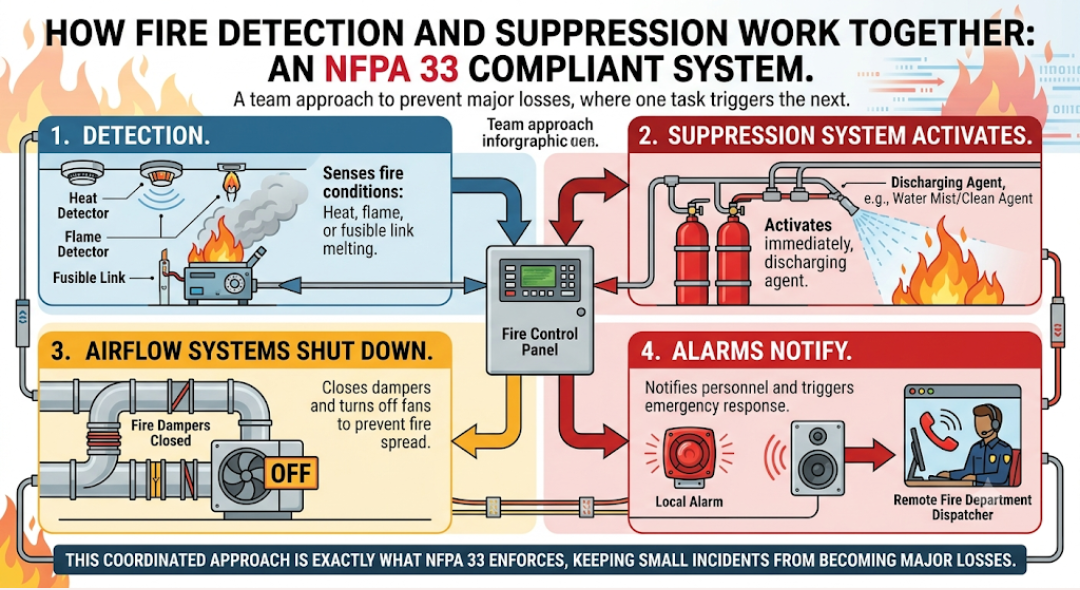
In a properly designed system, everything works as a team:
Detection (heat, flame, or fusible links) senses the fire and the Suppression system activates immediately. Airflow systems shut down to prevent fire spread and Alarms notify personnel and trigger emergency response
This coordinated approach is exactly what NFPA 33 is designed to enforce and it’s what keeps small incidents from becoming major losses.
Inspection and Maintenance: Where Many Facilities Fall Short
Of course, installing the right system is only half the battle. To stay compliant with NFPA 33 and ensure your system works when it matters most, you need:
- Regular inspections and testing
- Proper cleaning of overspray buildup
- System recharging after discharge
Neglecting maintenance can lead to:
- System failure
- Increased fire risk
- Compliance issues
- Costly downtime
Choosing the Right Fire Protection Partner
Paint booth fire suppression isn’t a DIY project. It requires a deep understanding of:
- Industrial hazards
- NFPA standards
- System integration
- Real-world application environments
That’s why it’s important to work with a provider who specializes in industrial fire protection.
At IFP, we design, install, inspect, and service fire suppression systems specifically for high-risk environments like paint booths. Our team understands how to match the right system to your specific hazards, ensuring both safety and compliance.
If you’re working in manufacturing, automotive finishing, or any industrial coating process, you can also explore more about how we support these environments on our industrial services page: https://www.candoifp.com/industrial.php.
Protect Your Process, Not Just Your Building
Paint booths come with real risks. The right fire suppression system doesn’t just protect your facility. It protects:
- Your people
- Your equipment
- Your production timeline
- Your bottom line
If you’re unsure whether your current system meets NFPA 33 requirements, or if it’s time for an upgrade, now is the time to take a closer look. Let’s make sure your paint booth is protected the right way.